
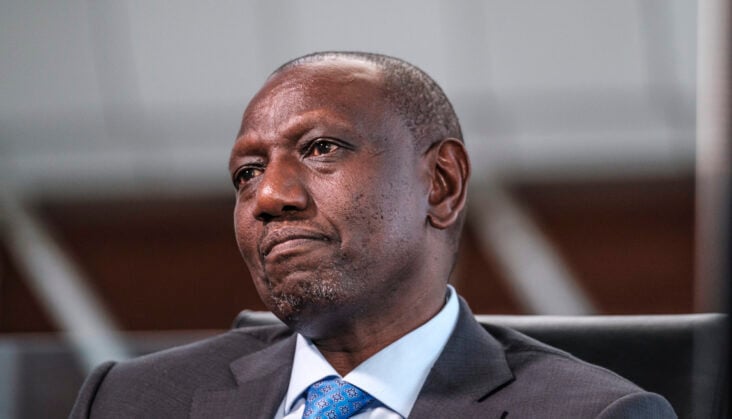
Ahead of his swearing-in as Kenya’s fifth President, Dr William Ruto has promised to confront barriers to success of every Kenyan, giving himself the tough job of, among other things, fighting the runaway corruption that has blocked the masses from opportunities or possibilities.
“Ethnicity cannot be a barrier; your social status cannot be barrier; religion you profess cannot be a barrier,” Dr Ruto told CNN’s Christiane Amanpour on September 7, a week to his taking oath of office to succeed President Uhuru Kenyatta as the head of State.
Asked to put his ‘Hustler’ philosophy into perspective, he compared the Kenya he seeks to build to America, which has been described as the land of possiblities.
“Kenya, with my candidature and with winning this election, the child of every Kenyan can know that they can live their dreams and actualise their dreams irrespective of whatever background they come from”.
This has been Dr Ruto’s rallying call since he became Kenya’s Deputy President in 2013 with Mr Kenyatta as his boss of 10 years, the second phase of five years having been tumultuous since the President entered into a pact widely known as Handshake with Opposition leader Raila Odinga.
In the August 9, 2022 election, Mr Kenyatta, who has not congratulated his deputy for the win, supported Mr Odinga who got 48.5percent of the votes against Dr Ruto’s 50.49percent, garnering 7.1 million votes.
According to the Kenyan Constitution, the winner of the presidential vote ought to garner 50percent of the votes plus one vote.
Armed with the gift of the gab, Dr Ruto told Kenyans through Amanpour’s 13-minute programme that “every child of any Kenyan can actually journey to…the pinnacle of any success, because it’s possible…so long as you they work hard”.
While he was saying this, many surveys in Kenya, including those commissioned by independent State agencies had found that some ethnic communities were holding a disproportionately bigger percentages of jobs with government institutions against the Constitution.
It is also an open secret that people were buying jobs, especially big positions, while the rest of the placements were ruled by the odd do-you-know-anybody lamentation that has become an alias for recruitment corruption.
In March 2012, a parliamentary report showed seven ethnic communities of the more than total 40 held 82percent of the jobs in the public service.
In the counties, the Auditor General led a team warning that more than 62percent of the 47 county governments were failing the ethnic and regional balance tests. According to the Constitution, no county, under the watch of governors, should employ more than 70 percent of the workforce from one community.
A number of government agencies were under the grip of a few communities, revealing how steep the challenge of uprooting the ethnic and social class is.
Having been an MP, an assistant minister, a minister and a deputy President, it remains to be seen the formula the incoming head of State will use to flatten the barriers in ensuring all and sundry, especially the youth, achieve their dreams by “working hard” as he said.
Apart from access to government jobs, the youth choosing to run own business or become their own bosses have encountered steep barriers, raising the cost of doing business.
Among the enterprise barriers in Kenya are innumerable licences, taxes, costly rent, expensive electricity, limited training, inaccessible credit, and weak incubation programmes.


