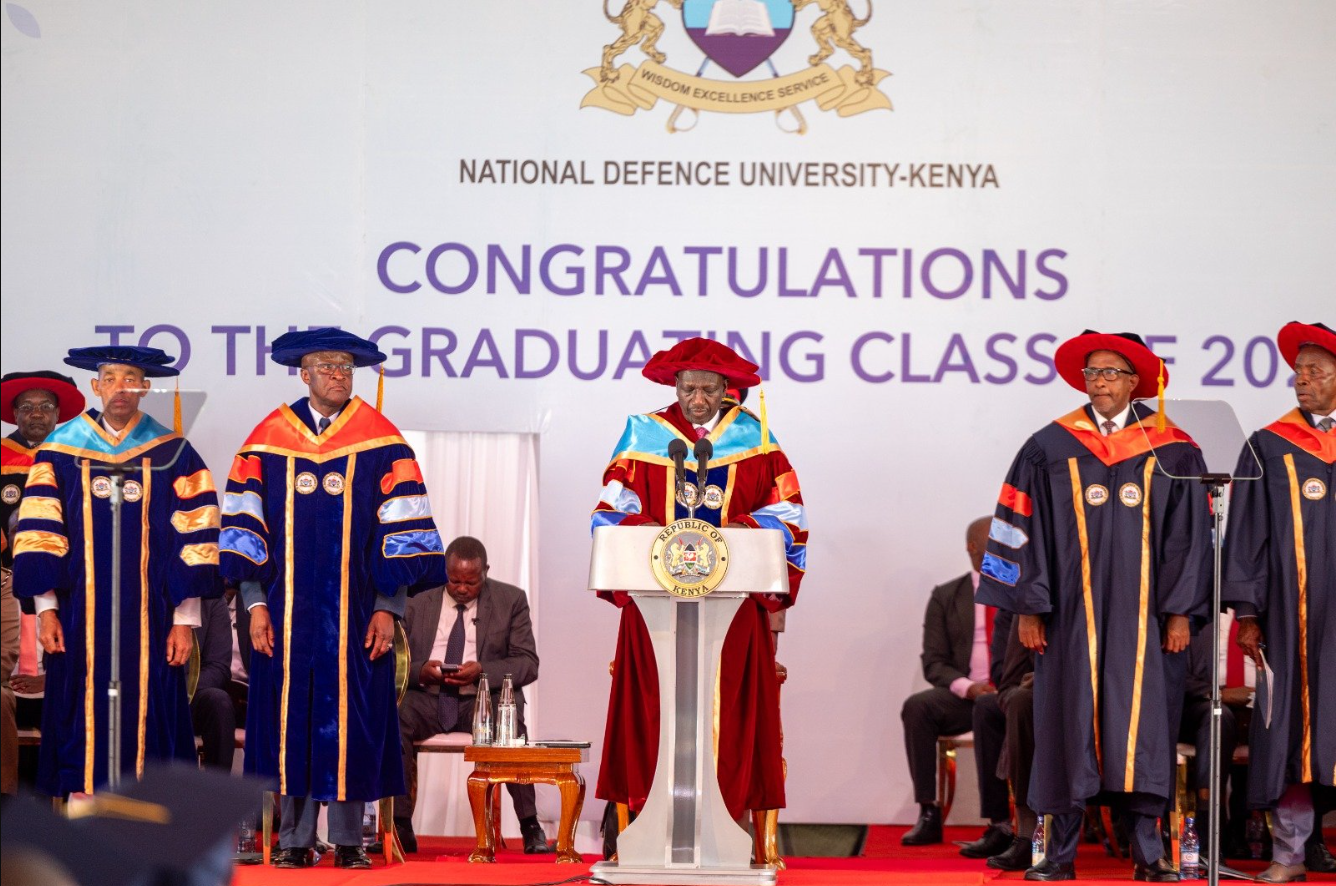
Two years after getting a charter, Kenya’s National Defence University has conferred degrees and awarded diplomas to 167 graduands at its inaugural ceremony on November 17.
In an event in Lanet, Nakuru, President William Ruto challenged the university to invest more in research and innovation as security and defence increasingly become strategic disciplines.
“In consideration of the broad scope of the emerging security mandate, and appreciating the complex and dynamic nature of contemporary security environment, I encourage the university to significantly increase its capacity for world-class research and innovation in order to develop effective solutions to current and emerging security challenges,” said President Ruto, who is also the chancellor of the university.
Dr Ruto said research and innovation “are the cornerstones of progress” that deliver “the tools to tackle difficult problems, the means of taking informed decisions, and access the opportunity to turn the tide of development in our favour.”
Those who get it right on innovation and research, the President said, stay ahead of the competition, threats and challenges.
Across the world, economies are investing billions of dollars in counter-terrorism strategies and related programmes such as money laundering to keep the threats at bay.
While Kenya’s security system had relied on partnerships and collaboration to train its personnel, the country realised shortcomings and established the defence university on May 27, 2021.
In a release, the university said Kenya needed an institution offering education infrastructure and training “that could foster integration of theory and practice, the hallmark of defence and security training.”
Among the graduands were 44 people drawn from a number of institutions in Kenya and other African countries who were awarded a master’s in national security and strategy.
Also Read: Education CS challenges graduates to solve problems
In Kenya, the graduands were drawn from the Kenya Defence Forces (KDF), National Youth Service (NYS), the police, National Intelligence Service, Kenya Forest Service, Foreign Affairs, and Interior that deals with internal security.
Others were from the Kenya Revenue Authority (KRA), Ministry of Health, Immigration, Agriculture, and Kenya Wildlife Service.
Apart from master’s, the different nationals from Kenya, Uganda, Nigeria, Rwanda, Malawi, South Africa, Nepal, and Botswana were graduated in postgraduate diploma and ordinary diploma.
Of these, 56 were awarded postgrad diploma in defence and strategic studies; higher diploma in critical care nursing (14); three graduated with diploma in defence and strategic studies; while 21 had diploma in national defence studies.
Maj Gen S.M. Farah, the vice-chancellor, asked the graduates to live the ideals of the university— excellence and service— by stimulating “great ideas” and inspiring others.
The university houses other KDF colleges and schools, namely the National Intelligence Research University College, National Defence College, the Defence Staff College, and the Kenya Military Academy.
Others are the Defence Forces Technical College, the International Peace Support Training Centre, Joint Command and Staff College, and Defence College of Health Sciences.
editor@aplain.co.ke