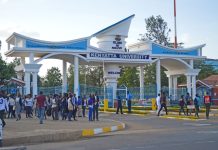
Moi University is one of the top Kenyan universities missing from a list of 172 PhD candidates who have been awarded Sh110 million government research grants that delayed for three years.
Kenyatta University tops the list with 42 beneficiaries of the National Research Fund (NRF) allocations while the University of Nairobi is second with 30. Among the private institutions, Mount Kenya University (MKU) is the best with five awards while Strathmore got two and Kenya Methodist University (Kemu) one.
Jomo Kenyatta University of Agriculture and Technology (JKUAT) secured 21 awards, Maseno earned 17, Masinde Muliro got 14 as University of Eldoret and Egerton registered presence with eight each.
Also missing from the list is Technical University of Kenya (TUK), but its namesake in Mombasa (TUM) got a paltry two, beating Maasai Mara that has one.
Moi is one of the leading universities in Kenya with 28,944 students after the University of Nairobi — the oldest and many times favourably ranked in global polls — with 62,963, KU’s 58,319, and JKUAT at 34,170, according to the Economic Survey 2020.
Kenya’s public university enrolment stands at 412,845 while the figure rises to 509,473, including private institutions. Public universities have seen their student enrolment drop steadily in the last four years while the private trainers have gained, perhaps helped by the concerns that quality is going down at the State universities.
The NRF — a relatively young agency hived off from the National Commission for Science, Technology and Innovation in 2014 — that supports scientific research this week announced a total $10.6 million (KSh1.06 billion) for the 172 PhD researches and what it called multidisciplinary projects.
According
to the University World News that spoke
with the Fund’s acting CEO Jemimah Onsare, the multidisciplinary projects are taking
the lion’s share of $9.5m (KSh950 million), leaving about $1.1 million (Sh110m)
for the PhD students.
This
was the second such award since the Fund was created. In the inaugural
allocations, $30 million (Sh3 billion) was awarded, meaning the current tranche
dropped to a third, mirroring higher education funding headache that has
persisted in Kenya for years.
Since the Commission for University Education announced that only PhD holders would teach at university, enrolment for the qualification has gone up, increasing the search for funding averaging Sh1 million required to complete the programme.
Of the 58 multidisciplinary researches, 51 will be carried out at universities while the rest will be taken up by State agencies like the Kenya Medical Research Institute (Kemri) that secured two.
The Kenya Marine Fisheries Research Institute, National Museums of Kenya, Kenya Industrial Research and Development Institute (KIRDI), Kenya Agricultural and Livestock Research Organisation (Kalro), International Service for the Acquisition of Agri-biotech Applications (ISAAA), and Good Life Trust will each get one project funding.
Among the well-known researchers benefiting from the funding is Prof James Tuitoek, a former vice-chancellor of Egerton University. Prof Tuitoek, an animal nutrition and livestock production expert, will be examining earthworm meal as an alternative protein source for poultry feed in Kenya.
Kenyan poultry farmers perennially cite the prohibitive cost of feeds as a challenge to the business that supports thousands of households. According to the Economic Survey 2020, marketed production of chicken and eggs stood at Sh9 billion in 2019, a drop from Sh12 billion a year before.
Agriculture that grew by 3.6 percent last year, down from six percent in 2018, produces more than a third of Kenya’s Gross Domestic Product now estimated at more than Sh8 trillion.